What Hartford business owners should look for in a commercial plumber
By Lena Vogel · Updated 2026-07-16
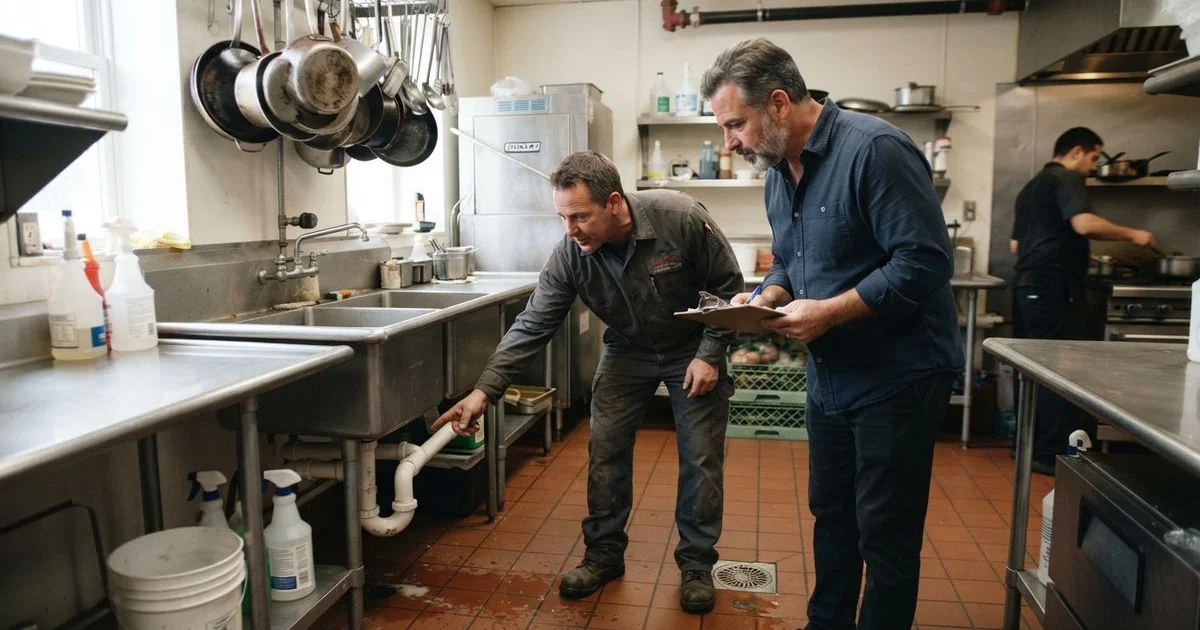
A plumbing failure at a business isn’t just an inconvenience, it can mean a closed kitchen, an unusable restroom, or a halted operation, which changes what matters when choosing who to call.
What’s different about commercial work
Commercial properties often involve equipment and code requirements that residential plumbing doesn’t: grease traps for food service, backflow preventers required by code, larger-capacity water heaters, and multi-fixture restrooms that see far more daily use than a home bathroom. A plumber comfortable with these systems moves faster and avoids costly missteps that someone used to only residential jobs might make. Regular inspections and testing schedules, like backflow testing, are also often a compliance requirement rather than an optional extra, which adds a layer most residential plumbing doesn’t have to think about.
What to ask before hiring
Ask about experience with properties like yours specifically, a restaurant’s needs differ from an office building’s, which differ again from retail. Ask about response time for both scheduled maintenance and true emergencies, since a slow response to a shut-down kitchen or restroom has a direct cost to your business that a home repair delay doesn’t carry in the same way.
Table: questions worth asking
| Question | Why it matters |
|---|---|
| Have you worked with businesses like mine before? | Commercial systems vary a lot by property type |
| What’s your emergency response time? | Downtime has a direct cost for a business |
| Do you offer scheduled maintenance plans? | Prevents failures rather than just reacting to them |
| Are you familiar with local commercial code requirements? | Grease traps, backflow preventers, and similar systems are inspected |
| Can you provide commercial references? | Shows a real track record, not just residential work |
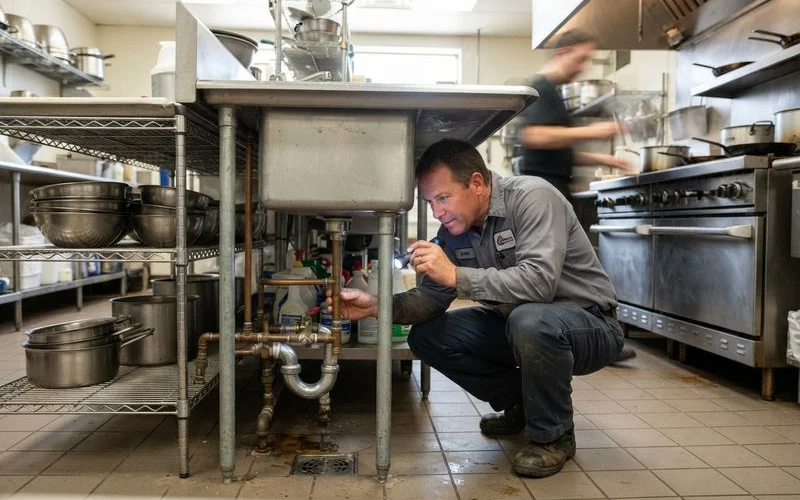
Consider an ongoing relationship, not just a one-off call
Businesses that wait until something breaks to find a plumber often end up choosing whoever answers the phone fastest, not necessarily the best fit. Setting up a maintenance relationship with a plumber who already knows your building’s systems, your grease trap schedule, your backflow testing requirements, pays off when something does go wrong, since they’re troubleshooting a system they already understand instead of starting from zero.
A maintenance relationship also tends to catch small issues, a slow drain, a fixture starting to fail, before they become the kind of failure that shuts down operations mid-shift. For a restaurant or any business where a plumbing failure directly stops revenue, that preventive angle is often worth more than a slightly lower hourly rate from an unfamiliar provider.
Getting quotes for larger commercial jobs
Commercial jobs, from a full kitchen plumbing installation to a backflow preventer replacement, are worth getting more than one quote on, the same way you would for a smaller residential repair. Ask each provider to itemize what’s included, since commercial estimates can vary widely based on equipment and code requirements assumed. Ask specifically whether the quote accounts for any required inspections or code compliance work, since that’s an area where commercial jobs differ most from residential ones and where an incomplete quote can turn into a mid-project surprise. Much of the basic vetting overlaps with residential hiring too; see our first-time homeowner’s guide to hiring a plumber for the residential version of the same questions.
Scheduling around your business
Larger commercial jobs often need to work around your operating hours, not the plumber’s. Ask upfront whether they can schedule disruptive work overnight, on a slow day, or during a planned closure, and whether that flexibility affects the price. A provider used to working with businesses will usually have a straightforward answer to this; one who hasn’t thought about it before might not be the right fit for a job where downtime has a real cost.
Where to start
This directory’s ranking method weighs responsiveness and completeness, both of which matter directly to a business that can’t afford a slow or incomplete fix. You can compare commercial plumbing providers in Greater Hartford through our directory before you’re in the middle of a shutdown deciding under pressure.
FAQ
- How is commercial plumbing different from residential plumbing?
- Commercial systems are often larger in scale, may involve grease traps, backflow preventers, or multi-fixture bathrooms, and downtime has a direct business cost, so speed and code compliance both matter more.
- What should I ask about response time?
- Ask specifically about after-hours and emergency response, not just business-hours availability, since a plumbing failure that shuts down a kitchen or bathroom doesn't wait for your normal schedule.
- Do commercial plumbers need different licensing than residential plumbers?
- Licensing in Connecticut covers plumbing broadly, but experience matters here more than a separate license. Ask specifically about their track record with commercial or multi-unit properties, not just homes.
- Should I set up a maintenance relationship instead of calling only when something breaks?
- For most businesses, yes. A plumber familiar with your building's systems responds faster and more accurately than one seeing it for the first time during an emergency.